
By Judy Scott Feldman
Update: This proposed alternative location for statues on the museum-lined open space on the Mall would require Congress to authorize a site in Area I or in the Reserve as defined in the Commemorative Works Act and could be part of a forward-looking 3rd Century Plan for the Mall.
For more than two decades, I have given talks on the history of the National Mall, often ending my overview with a few modest proposals for its future, including expanding the Mall boundaries and creating a “Statuary Hall on the Mall.” Audiences – civic groups, tour guides, and visitors – seem enthusiastic about the possibilities. Enlarging the Mall, as the 1902 McMillan Plan did when it extended the Mall westward to include the Lincoln Memorial, could open space for future museums and monuments, which keep coming despite Congress declaring the Mall a completed work of civic art in 2003. Small-scale statues lining Mall pathways could engage visitors in a deeper, richer civic experience on the Stage for American Democracy.
Now President Trump is considering a National Garden of American Heroes to celebrate America’s 250th anniversary, in Washington DC, within West Potomac Park near the Jefferson Memorial, I should be happy, right?
If it moves ahead, this Garden could expand the reach of the Mall beyond its historical boundaries while conveying American history. But it also could eliminate public recreational green space now used daily by local families, youth sports leagues, and community groups on popular baseball fields, and could also impact a public golf course. Congress created “Potomac Park” in 1897 on reclaimed land (landfill) dredged from the Potomac River by the US Army Corps of Engineers in 1880s “to be forever held and used as a park for the recreation and pleasure of the people.”
There also are serious, unresolved environmental risks. This man-made land often floods during heavy rains. The ground itself is subsiding. The National Park Service’s ongoing seawall project is intended to mitigate flooding along the Potomac shoreline. But in public meetings for that partially funded project, NPS could not show that the higher seawalls would protect memorials along the Tidal Basin, including the Martin Luther King Jr. Memorial and the FDR Memorial whose walkways along the Tidal Basin are often under water at high tide. Has anyone seriously asked if it’s even possible to solve flooding and subsidence problems before installing the statues by July? How will the American people coming to Washington for our 250th celebration feel about the future costs of maintaining a partially submerged “National Garden of American Heroes”?
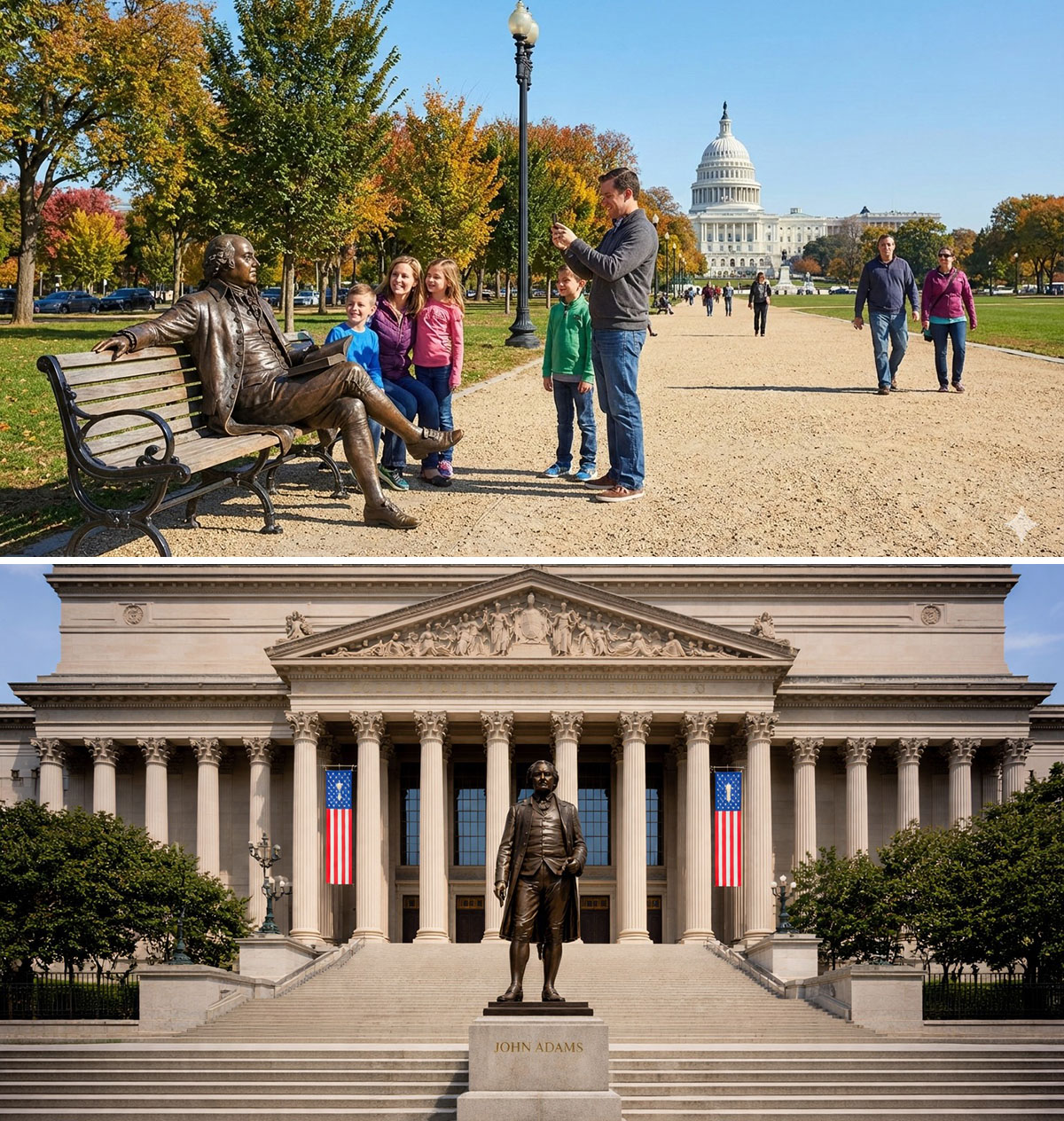
If the goal is to celebrate American history in a prominent and meaningful way, there is a better answer, and it’s hiding in plain sight: along the great east-west axis between the Mall monuments and Smithsonian museums, where school buses and tour buses already discharge millions of visitors every year. Small-scale statues lining the Mall’s pathways, from the Capitol to the Lincoln Memorial, could enliven the two-mile walk with stories from every corner of the American experience. As with the figures enshrined in the Capitol’s Statuary Hall, each state could choose its honorees, creating a democratic quilt. Unlike the Capitol’s statues, these would be accessible to the public around the clock.
Such an approach would add layers of history and meaning to the American story told in our national monuments and Smithsonian museums, and in the First Amendment activities that already define the Mall as the Stage for American Democracy. All without sacrificing recreational space or ignoring environmental and extreme weather realities.
For example, the long-awaited John Adams Memorial could occupy a bench in front of the National Museum of American History or greet visitors to the National Archives (see AI generated images above).
The Garden of Heroes is a valuable civic proposal that deserves greater deliberation in choosing its location. As noted in recent news stories, the Commemorative Works Act forbids building in the “Reserve” of which this land is part. But, as we’ve learned since its passage in 2003, Congress has already made exceptions to its own growth restrictions and, given the current political climate, may do so again.
At the same time, the Trump administration has sidelined the Commission of Fine Arts and reshaped the National Capital Planning Commission, leaving this consequential proposal to advance through an oversight vacuum.
Congress must act now. It should establish an independent commission of architects, engineers, historians, and planners to advise immediately on the Garden of Heroes and to prepare an updated, comprehensive McMillan Plan for our National Mall in the 21st century. The stakes are larger than one project. This is not just about ensuring a successful 250th anniversary but safeguarding the national landscape that embodies our democratic ideals as we look forward to the next 250 years.
• Judy Scott Feldman, PhD, is a founder and chair of the National Mall Coalition.


